Who Does This Work?
Those who gather the courage to take the next step and join this work discover something unexpected: despite their differences, they forge the closest friendships. What brings them together runs deeper than age, culture, or circumstance, for it is rooted in the very core of their being.
Through the years, I’ve marveled at the wide variety of people drawn to this work. It defies all expectations. Science attracts analytical minds, poetry attracts lovers of language, law attracts those who think in rules—but this work transcends such categorization. I’ve watched engineers and artists tackle it with equal passion, entrepreneurs and monks, teenagers and retirees, the religious and the skeptical, the successful and the struggling. I’ve traveled this path alongside those looking up from hardship with hunger as well as those looking down from privilege with hollowness. Their backgrounds always proved irrelevant. Despite their differences, each arrived at the same impasse, a point where neither their own efforts nor any conventional knowledge could help them break through. In search of a way out, they came from the farthest corners of human experience to the same gateway.
Take a young man newly-graduated from school, faced with the daunting prospect of charting his future. He watches his peers make consequential decisions with enviable certainty. One pursues a finance degree, another plans a backpacking trip through South America, and a third joins an ashram in India. He’s baffled at their confidence and feels paralyzed by indecision. The finance path seems soulless, the travel aimless, the spiritual quest pretentious. As the pressure to take his next step mounts, he realizes with growing despair that he lacks the tools to navigate these pivotal choices. His education has prepared him for exams, not for real life decisions. How can he know himself and use that knowledge to navigate through life? Through the door of this frustration, he arrives at this work.
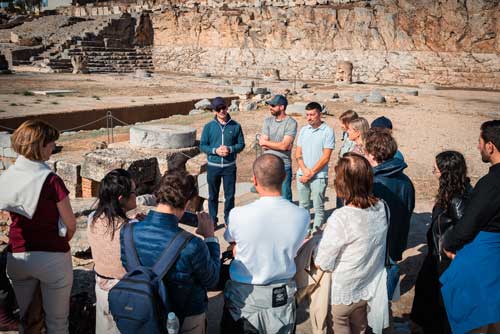
Old New Method practitioners visiting Eleusis, Greece
Or take a mother yelling at her five-year-old daughter for spilling juice—the very same reaction her own parents had in similar incidents and which she loathed as a child. The realization hits her like a physical blow. As she watches her daughter’s tears mirroring her own childhood pain, she experiences a desperate desire to be different. Years of therapy hadn’t prevented her from repeating the very patterns she’d sworn she would break. But there must be a way to break free from the grip of these habitual behaviors, to stop them making decisions on her behalf. Through a different doorway, she arrives at the same threshold.
In quite different circumstances, a man in mid-life finds himself sitting in a cold prison cell. The drug smuggling job was supposed to be his ticket out of poverty, a one-time risk for a lifetime of financial stability. Instead, it’s landed him a year-long sentence and a criminal record that will haunt him forever. As he stares at the gray walls, he replays the sequence that led him here: the dead-end jobs, the mounting debts, the desperation that made an illegal shortcut seem justifiable. How can he escape being constantly dragged along by circumstances? How can he learn to respond rather than react? This painful epiphany, born in the stark reality of his confinement, opens yet another doorway.
Or take an ambitious executive who had rushed to the hospital to see her dying father. He had been hit by a car and suffered injuries from which he wouldn’t survive. His last words—”Is this all life has to offer?”—echo in her mind as she drives home, sobbing. The shock triggers a self-questioning she’d repressed till now. Who is she sobbing for? Her father, who no longer feels pain, or herself? And don’t his dying words put her entire life in question? The relentless climb up the corporate ladder, the carefully curated education for her children, the meticulously planned family vacations—she’s followed society’s blueprint for success to the letter, yet her father’s final doubts suggest a fundamental flaw in this approach. As she pulls into her driveway, the sight of her perfect suburban home suddenly feels hollow. What does life really have to offer? She finds yet another doorway.
As another example, take a retired man sorting through his belongings, trying to thin out what he’s accumulated. He finds a photo of himself in his prime—confident, ambitious, full of dreams. The gulf between that vibrant figure and his current self opens like a chasm. How did all those dreams amount to so little? Where did all the years go? And what can be done with the little time remaining? His awakening isn’t too late. From this soil may yet grow something that couldn’t come any other way. He, too, finds himself with the others—the graduate, the mother, the prisoner, the executive, at the same threshold.
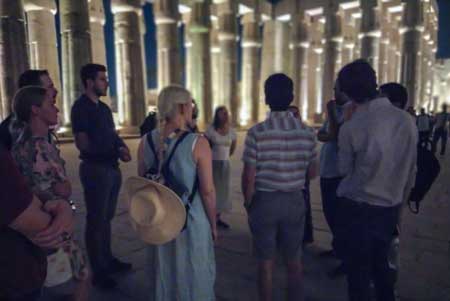
Old New Method practitioners visiting Luxor, Egypt
Those who gather the courage to take the next step and join this work discover something unexpected: despite their differences, they forge the closest friendships. What brings them together runs deeper than age, culture, or circumstance, for it is rooted in the very core of their being. And in this shared effort, the diversity that might have separated them becomes their greatest asset. The artist sees what the engineer cannot; the retiree recognizes what the teenager overlooks. They become, for one another, both mirror and guide. Despite having come from the farthest extremes of human experience—despite having suffered the isolation of their search—once they enter, they no longer walk alone.