
Online Gathering on
The Enneagram and the Three Poisons
A six-day online workshop that explores one wheel, seven types, and the possibility of change…
June 22 – 27
Three creatures chase and bite each other at the center of the Wheel of Samsara. Their inexhaustible pursuit powers everything we think, feel, or do. The satisfaction of one guarantees the dissatisfaction of another. This is the Buddhist diagnosis of our condition: our psychology is fundamentally arranged to perpetuate suffering. Join us for a six-day online course that combines the Tibetan Wheel with the Enneagram to map the specific form these three poisons take in each of us.
The gathering will be at a cost. The meetings will be recorded and made available for viewing afterwards. Read more below:
The Three Poisons
The Wheel of Samsara is a Buddhist map of conditioned existence. It displays the possible realities into which beings may be born, live, and die — only to be born again. Its rings are causally linked: one’s relation to the center determines which realm one inhabits in the middle circle, which in turn perpetuates the cycle of rebirth in a realm of the outer rim. Since the hub is the origin of the wheel’s rotation, we begin by taking a closer look at the hub.
At the center of the Wheel, three animals bite each other: a pig, a snake, and a rooster. The pig represents ignorance; the snake represents aversion; the rooster represents desire. An irreconcilable swing between desire and aversion is kept in motion by our ignorance. This is the Buddhist diagnosis of the human condition: our psychology is structurally arranged to perpetuate itself through contradiction. We cannot remove the snake or the rooster; desire and aversion are hard-coded into our nature. But we have some measure of control over the pig. We can dispel self-ignorance by becoming conscious of these dynamics, and this opens up the possibility of altogether escaping the cycle.
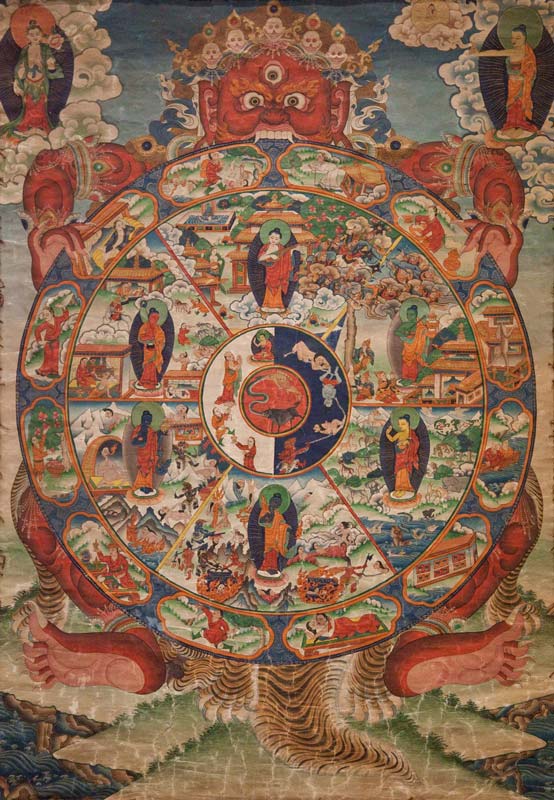
Wheel of Samsara| Tibetan Thangka 1800-1900 C.E.
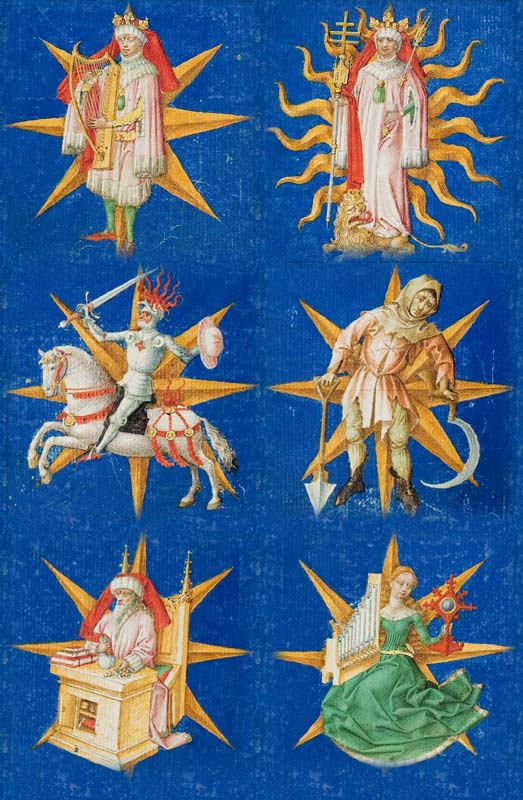
Planetary Types | Adapted Illuminated Manuscript 1465-70 C.E.
The Enneagram | The Map of Types
The Enneagram sheds light on this ignorance by mapping the full spectrum of human types and their corresponding features. These ‘features’ are the snakes and roosters of our psychology, the deepest elements that drive our behavior. For a feature to function as an ever-rotating engine, it must possess an irreconcilable contradiction. Otherwise, once appeased, it would stop. For example, a feature of vanity drives us to attract attention, but once we get attention we become shy. Vanity is the rooster; shyness the snake. Or: generosity drives us to give, but after giving, even if we are genuinely needed, we feel overwhelmed and resentful. Generosity is the rooster; resentment is the snake.
The Enneagram outlines seven such features which correspond to each of the traditional planetary types:
- Lunar – Willfulness
- Venusian – Non-Existence
- Mercurial – Power
- Saturnine – Dominance
- Martial – Destructiveness
- Jovial – Greed
- Solar – Naïveté
Once we understand the dynamics of these features and learn our location on the Enneagram, we remove the pig of ignorance by shedding light onto the very core of our behavior.
Group Work | What You Cannot See Alone
The pig of ignorance is deeply entrenched. It will not easily give way to understanding. For one, we do not even suspect our psychology is governed by features. Then, even on being told, we remain ignorant because we are too much inside of them; our features themselves organize our perception. And finally, even when we do witness a manifestation of our feature, we immediately judge and justify what we see as an isolated and exceptional incident, thereby guaranteeing the mechanism will continue.
Therefore, removing the pig of ignorance can only happen alongside other practitioners. The group must comprise different types who together cover all the positions on the Enneagram. It must also have some practitioners with experience observing themselves. One may not be able to see one’s own features, yet still recognize them in another practitioner’s observations.
Our study will span six consecutive days. Each day will focus on a specific feature, aiming to understand how it perpetuates itself through the desire and aversion dynamic. After we present the theory behind each type, participants will be invited to share observations of its manifestation in their daily lives. Ultimately, the goal is not to eliminate the features but to leverage their predictable recurrence; to use what is most mechanical in us as the very instrument of becoming conscious.
Online Session

Online gathering on
The Enneagram and the Three PoisonsJune 22 – 27|3pm and 8pm UTC