Hoisted Higher
In the play we performed in Italy this past month, I cast Luisa as Demeter—the lead role in a retelling of the Greek myth of the harvest goddess whose daughter Persephone is abducted to the underworld by Hades. Having no prior theater experience, the challenges before Luisa were considerable….
Luisa is a social worker who accompanies women as they are leaving prison. She helps manage their transition back into the world. She works to build the optimal conditions for them to resume their lives after incarceration. She is, in other words, someone who holds others up. “The biggest challenge in my job is giving people confidence before they’ve found it in themselves,” Luisa told me, “—and learning to accept my own powerlessness, when the way forward is clear to me but invisible to them.”
In the play we performed in Italy this past month, I cast Luisa as Demeter—the lead role in a retelling of the Greek myth of the harvest goddess whose daughter Persephone is abducted to the underworld by Hades. Having no prior theater experience, the challenges before Luisa were considerable. She had to memorize a sizable number of lines, assume the posture and bearing of a goddess, and credibly exhibit the anguish of a mother who has lost her daughter while the gods turn their backs. For the duration of a week, Luisa was no longer a social worker, but a goddess. The group’s eyes were on her. The structure of the play depended on her. And she met it with an understanding of the benefit in being stretched past her habitual range.
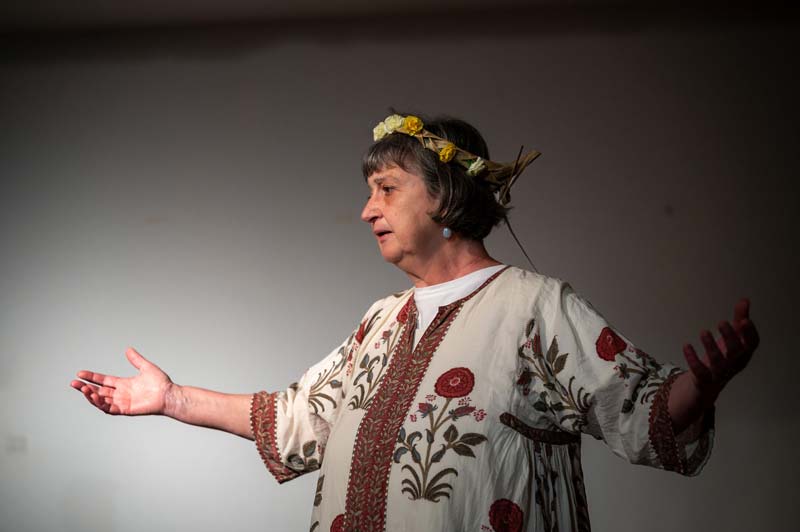
“I’ve never done anything like this,” Luisa told me during an intermission between rehearsals one day and after a particularly demanding session, where the director persisted in pulling out convincing emotions from Luisa. “You are Demeter!” said the director; “You are fuming, exhausted, betrayed, yet hopeful—how would all that look?” As best as I could read Luisa’s face, she seemed to be at her wits’ end as to how to impersonate such a complex cocktail of emotions. “It’s terribly challenging,” she told me later “—but I’m well aware it’s a unique opportunity to step outside of myself and experience being someone else.”
Every practitioner who showed up to rehearsal helped Luisa hold the structure of the play in place throughout the week. The group served as her pedestal. And this, I have come to understand, is one of the less obvious gifts of working in a group, one that no amount of private effort can replicate. Left to ourselves, we set our own pace, follow our own rhythm, and avoid the discomfort of being seen in our weaker moments. These apparent advantages are the very thing that keeps us in place. Growth requires a pressure we rarely generate alone and cannot manufacture on demand. It must come from outside of us, which means it must come from others.
In her daily life, Luisa is the one who holds others up, who lends confidence to people who do not yet possess it, who stands steady while others find their footing. In that week in Italy, that dynamic was turned on its head. For once, she was the one being held. The group beneath her; the role above her; and Luisa, reaching toward something she had never before been asked to reach for.
“It was a very strong experience,” she told me as I congratulated her after the final performance, “I feel it in every cell of my body. I believe it was also a transition. Thank you for moving me through this process, and giving me the confidence that I could stay with it.”
If Luisa can carry a trace of this ‘incarnation’ into her ordinary life—the discovery of playing a role without being swallowed by it, moving through familiar situations with the same gestures and words but without the unconscious identification that normally governs us—then the immense efforts of staging an entire play were worthwhile. And if she can see the social worker as merely another role she’s tasked with, one to be performed with the same professionalism she attempted when performing Demeter, then she will have learned a lesson useful for the rest of her life—and one only possible to learn in the context of group work.
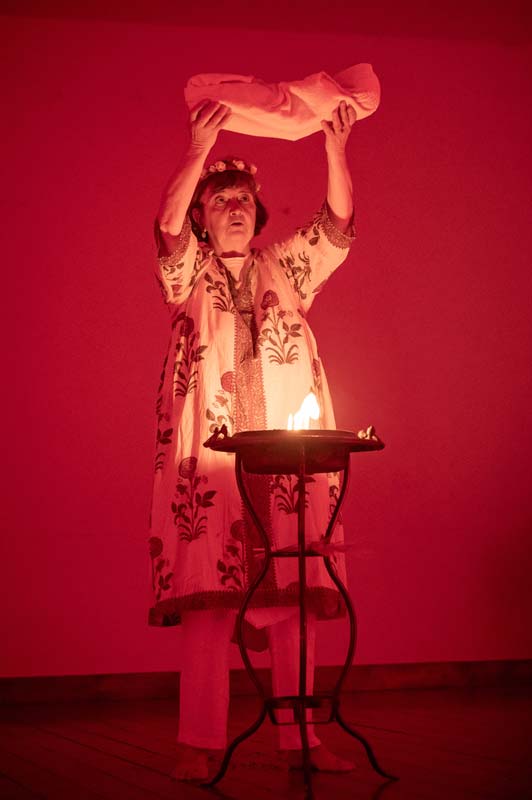
And in our next gathering, she will be part of the pedestal for hoisting someone else.