
Old New Method Gathering in
MilanJoin us to explore the artistic treasures of Lombardy’s capital…
April 12 – 18, 2026

Milan is a crossroads of sacred traditions, where early Christian basilicas stand alongside Gothic cathedrals and Renaissance masterpieces. From the 4th-century foundations of Sant’Ambrogio through the soaring spires of the Duomo to Leonardo’s revolutionary experiments in perspective and symbolism, this northern Italian city preserved centuries of esoteric knowledge in stone, mosaic, and paint. Each period found its own language to express eternal truths, which we will trace throughout our week together.

The Duomo
Construction of Milan’s main cathedral began in 1386 and continued for nearly six centuries resulting in one of the largest Gothic structures ever completed. Its forest of spires—135 in total—reaches toward heaven with mathematical precision, while its interior creates a vast space designed to shift awareness through the interplay of light, shadow, and vertical proportion.
A depository of art spanning such a length of time is bound to carry valuable treasures. Here we will witness hints of the inner meaning of Eve’s transformation into Mary and the unsuspected roots of Christianity in Ancient Egypt, as well as the role of a church as an Ark meant to preserve its contents through the floods of time.
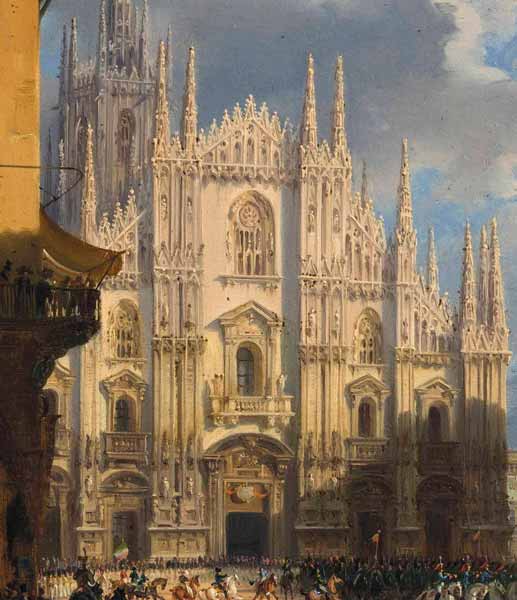
The Duomo of Milan | Giovanni Migliara | 1785-1837
If we take history in the ordinary way as a series of separate events, we shall not find proofs of esotericism. One thing will follow another, on the surface and without apparent connection. But if we know that things are connected, and look for connections, we shall find them hidden beneath the surface. For instance… Gothic art seemingly came out of nothing. It had no history, it appeared instantly.
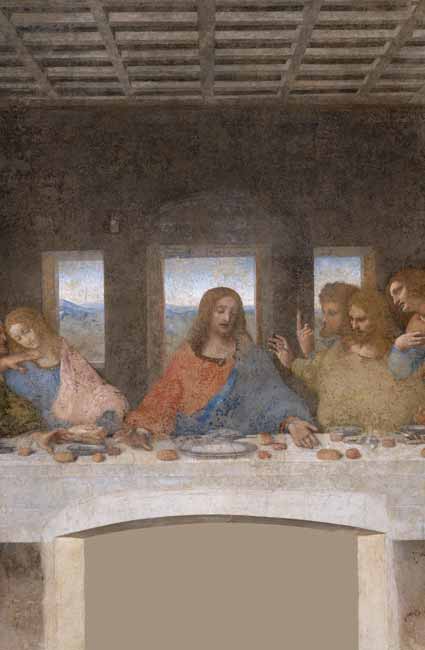
The Last Supper (detail) | Leonardo da Vinci | 1495-1498
Leonardo’s Last Supper
The Duke of Milan Ludovico Sforza commissioned Leonardo da Vinci to paint the Dominican friars’ refectory wall in Santa Maria delle Grazie, resulting in one of the most studied images in Western art. Painted between 1495 and 1498, The Last Supper captures the moment when Christ declares that one of his disciples will betray him. While this scene is commonly featured in monastery and church refectories, Leonardo added a depth and nuance never seen before or after. His work demonstrates how great art serves as more than decoration; it functions as a precise instrument for transmitting knowledge across the centuries.
We studied this painting during the online gathering on the Twelve Functions. Every gesture, every arrangement of hands and eyes, every spatial relationship, conveyed something about each of the twelve, which in turn reflected the nature of our internal divisions. In Milan, we will enjoy the privilege of examining this work face to face.
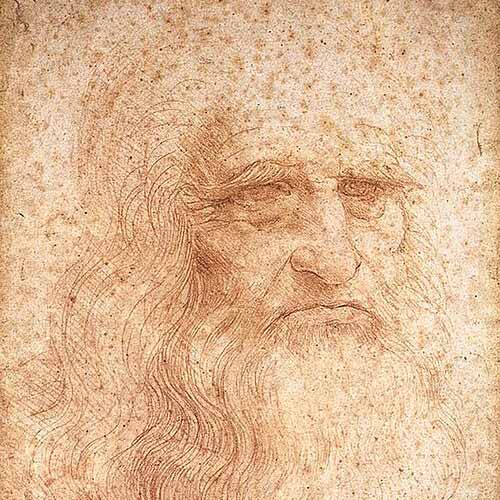
The painter has the Universe in his mind and hands.
Leonardo da Vinci
The Brera Gallery
The Pinacoteca di Brera houses one of Italy’s finest collections of Renaissance and Baroque painting. We will study works by Raphael, Caravaggio, and Mantegna—among others—and examine their approach to Christian themes familiar to us from our studies. In Bellini’s St. Mark Preaching in Alexandria, for example, we will witness one of the seventy-two disciples disseminating Christianity throughout the world, an idea whose inner meaning we explored during the Twelve Functions.
Bramantino’s Crucifixion will be another meaningful work to examine. Christ is shown nailed to the cross between the “Good Thief” and the “Bad Thief” in a scene rich with esoteric significance. Both speak to him in this final moment of earthly existence, as if offering him a final test: which voice to choose. Such unique representations of familiar scenes reveal a painter’s insight into their inner meaning. It also reveals that the inner meaning of Christian stories was always known to some, and reliably handed down from one generation to another.
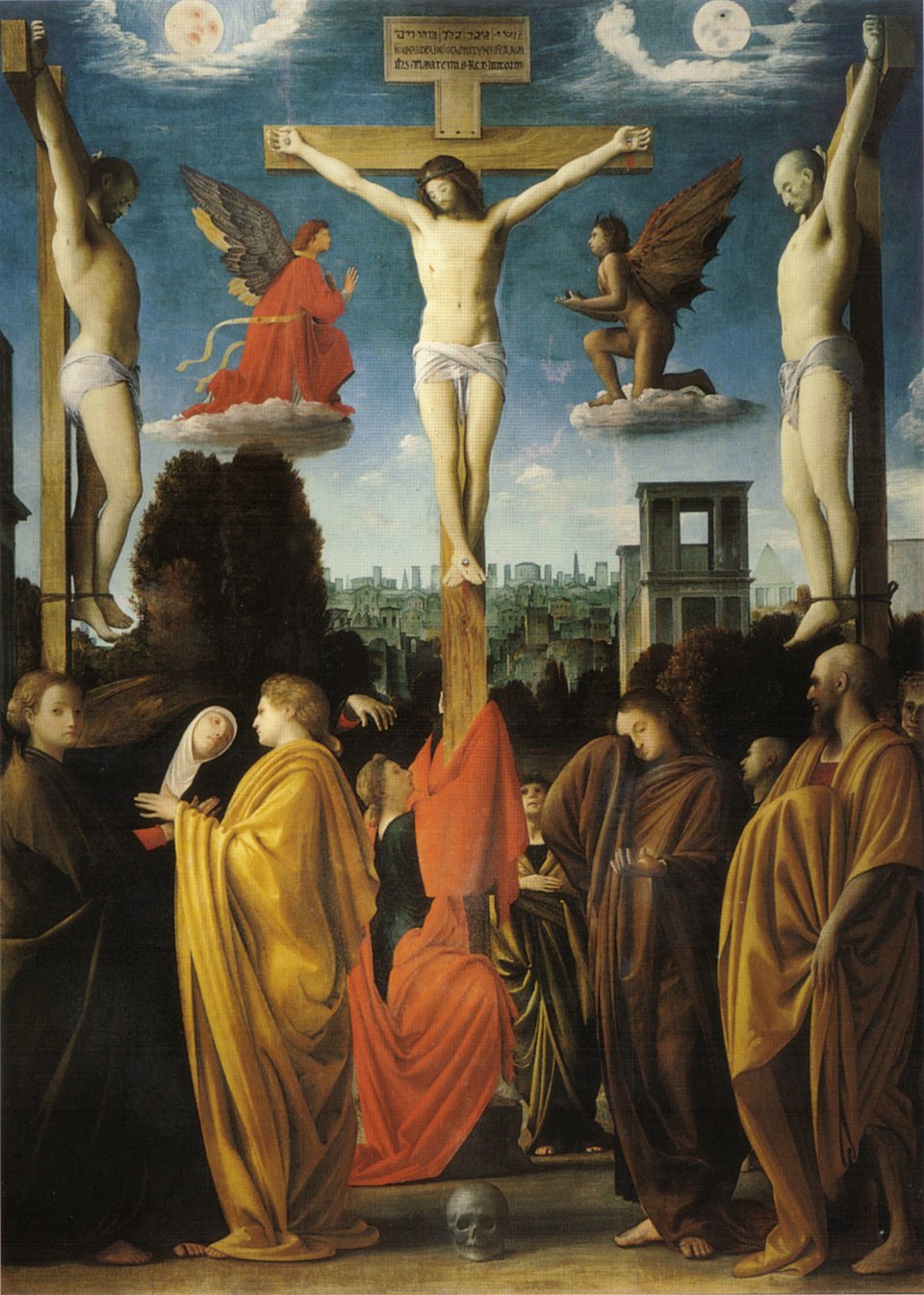
Crucifixion | Bramantino | 1503–1511
A real artist is one whose work has begun to reflect or harmonize with some aspect of the plan. This may happen unconsciously by sheer whole-hearted devotion to one’s line. Or it may happen consciously, when a person begins to understand the nature of the plan, and the conditions of men’s participation in it.
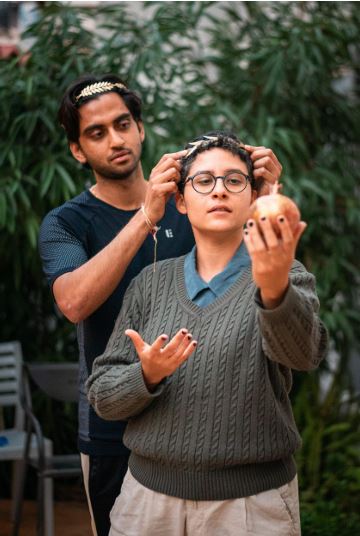
Old New Method Students in Rehearsal | Athens 2025
Theatrical Performance: The first Harvest
Throughout our week, we will prepare a theatrical presentation titled “Not Even God”—an exploration of divine limitation and cosmic law drawn from the teaching that even the Absolute must work through established principles rather than acting arbitrarily. The story examines how higher influences cannot intervene directly in lower realms without destroying them. Transformation must therefore come through our conscious effort, from below, meeting conscious influence from above.
Our evenings and nights will be spent in rehearsal, engaging all three functions—intellectual, emotional, and motor—to create the conditions for genuine understanding. Ancient teachings were always meant to be enacted, not merely studied. Through the pressure of preparation and the vulnerability that performance brings, we create opportunities for insights that reading or discussion alone cannot produce.
Towards the end of the week, we will travel to Benevento to perform our play on the final evening of our gathering.
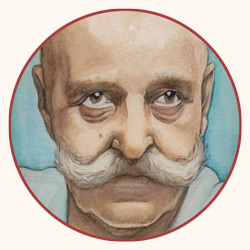
Every real religion consists of two parts. One part teaches what is to be done. The other part teaches how to do what the first part teaches. This second part is preserved in secret in special schools.
Old New Method Gathering in
MilanJoin us to explore the artistic treasures of Lombardy’s capital…
April 12 – 18, 2026